
Life Lessons During Lent
/Dear family and friends,
When I graduated from medical school, I was asked what I would specialize in.
My fast answer was “everything.” I needed to be like the old-fashioned general practitioner, because in Haiti there is a dire lack of doctors.
The response was, “Only God can be good at everything!” Yes, true. But in very poor settings we have at least to try!
This exchange intrigued me enough to make me wonder,
“Does God have a specialty?”
For sure, the Christian God has a specialty. It is calling forth life from the darkest, and coldest, ashes of total devastation,and teaching others how to cultivate the spiritual power to do the same.
For some people, it takes unimaginable spiritual power just to put one foot in front of the other and face another devastating day.
It can be hard to remember that God created us for life, life fully and life always, because our earthly experience of life is often quite the opposite. People, through sin and hatred, repeatedly generate a world which is painful, shocking and deplorable.
People easily get physically, mentally, emotionally and spiritually shipwrecked.
Each year, Lent reminds Christians of a perennial formula for healing.
When we are in the darkest places of life, where the ashes have all gone cold, the Bible offers an age-old medicine:
Pray more deeply,
Add fasting and personal sacrifices to your prayer.
And multiply many times over the good you do for the stranger.
This is God medicine.
At 72 years old, I have in fact gotten good at a lot of things, especially concerning priesthood and medicine.
But what good is it to recognize cancer if you can’t do anything about it? For example, Fara, who was 22 years, old just died today in our hospital. She was an albino and therefore highly susceptible to melanoma. She was ravaged by this cancer, in a country where the poor have no access to basic health care, never mind cancer care.
Knowledge and skill in any field, without a huge “we” bound together in institutional and networked ways, cannot even begin to do what must be done.
Yet, even with our limitations, in a country where the healthcare structure has been razed because of the kidnapping of doctors, medical personnel leaving as refugees, and burned hospitals, I am quite grateful that during Fara’s last agonizing days we could be helpful in a limited way. The Sisters and our team took the best possible care to manage Fara’s pain, and to keep very fresh and clean bandages on her many enormous wounds. And we did our best to be good, and prayerful, company for her.
I am also grateful that for some cancers we can still intervene early and save lives, especially in children.
Fara’s sister, Anne, is also an albino. For as overwhelmed as she was by Fara’s illness, she was amazingly faithful and tender to her sister. Her witness was a quiet and dignified heroism. Coming into our awareness because of Farah, we will now be able to keep a close eye on Anne and remove suspicious growths as soon as they appear.
Today we also received three gunshot people at our hospital, wounded nearby at the Tabarre Bridge. Innocent people, very poor people, trying to get through each day of this violence and chaos. The one who arrived a short while ago is Rachel, shot in both legs.
We don’t have the institutional strength to manage life threatening trauma, but it is very gratifying to be able to stabilize such victims. We do have networked strength, and were able to get them right away to the absolute best care- Doctors Without Borders. Lives of the innocent and unfortunate are often saved, because we all do our part, however small.
During the past few days, we had nearby neighbors fleeing violence once again. We saw some struggling to try to take things of value out of their houses as they fled, so we went with our truck to help them. They spoke to us about a house nearby with dead people in it, who all died with hands tied behind their backs.
We then understood that these were most likely kidnapped people, whose families could not afford their ransom, or who were abandoned by the gangs because of all the police-gang shooting in our area for the past weeks. This was especially disturbing to us, to die such a way, even their families not knowing their fate. We were determined to get their bodies for their families.
This is a lot easier said than done.
We would need legal authorization from a justice of the peace, and the local police, and we would need the bandits to agree to respect our entry into the area, and we would need the police of the special forces to respect our entry into the area.
In fact, by God’s grace and our level of credibility, we managed all of that.
Rather than a neutral white flag held high as a “don’t shoot” sign, me and the sisters wore our white habits, and Fr David wore his white cassock. In this way we trudged through the area. The tougher members of my team, who always come along loyally to help and protect, had no such robes to soften their raw and formidable determination, which they exuded.
The people had warned us that packs of dogs went often to that house. We knew what that meant. But we wanted, both humanly and spiritually, to stand up for the simple truth that the bones of human beings belong in a duly blessed grave, and not in the mouths of dogs.
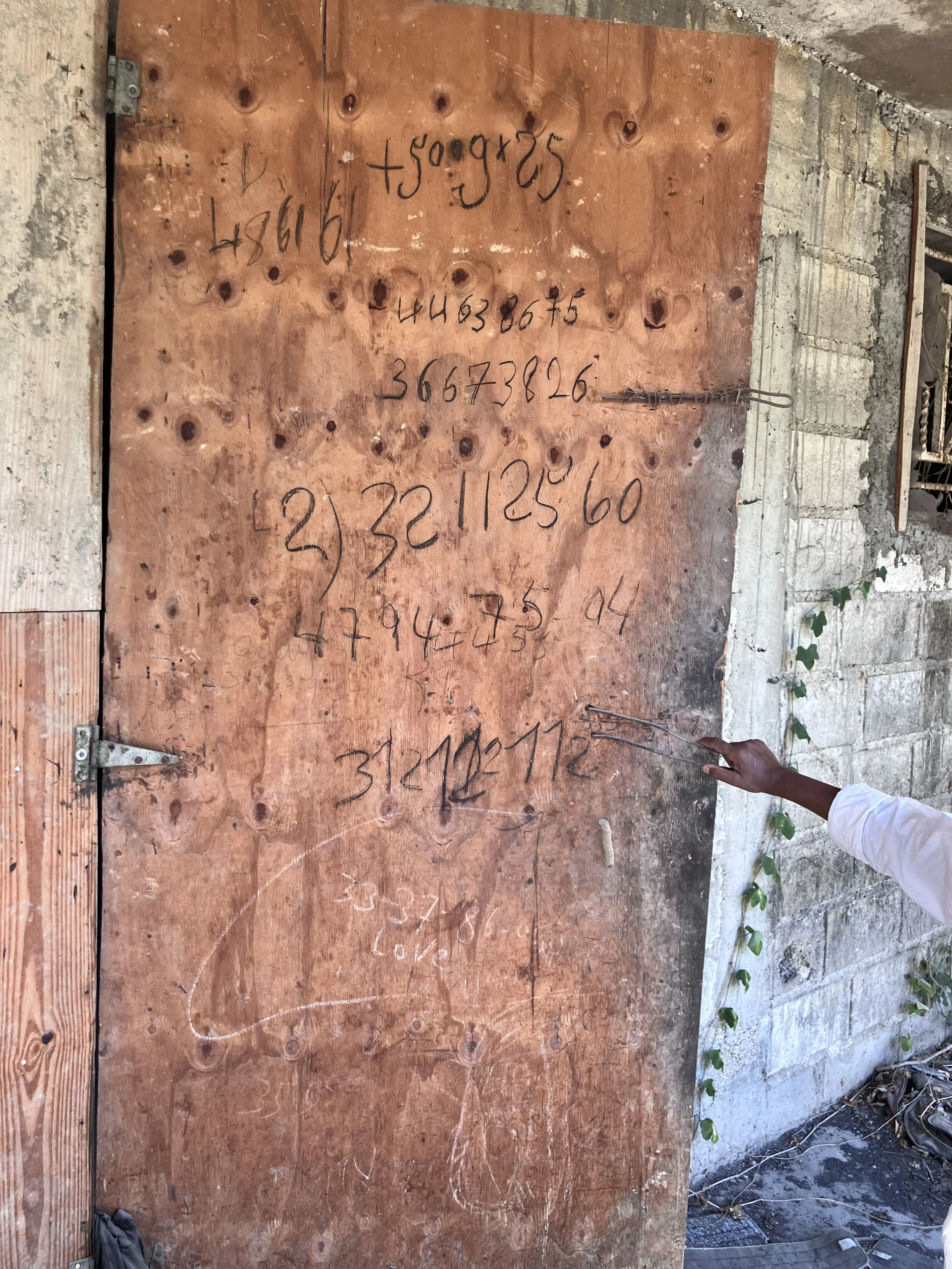
We found the rooms where these people died. Dirty clothes were scattered around the floor, there was a shoe here, a sandal there. Thick dust and grit. But the bodies were gone. And on the filthy walls were scribbled phone numbers in charcoal.
The kidnappers write the phone numbers of the families of the kidnapped on the walls, as their convenient “paperwork” to make ransom calls. By looking at the numbers, were looking at the last link between those who died in these rooms, and their loved ones at home. It was sobering.
We used to be good at freeing kidnapped people, through credibility and dialogue and bartering in humanitarian needs. But as bandits have gotten more and more radicalized and widespread, it has become very difficult. It is hard now to achieve,
For as painful as it was looking at the wall of phone numbers, I also was as relieved and grateful for the many times over the years that we were able to free kidnapped people and return them to their families alive. Including children. It is so worth the risks and the dangers.
I know that my letters can be discouraging to read, and I will never be accused of having a rosy view of the world. But I am just one of millions of people, in myriads of professions, who cannot avoid seeing the world in its starkness, although also in its beauty.
This brings me back to God’s specialty, which God is eager to share with us. How to live the difficulties of life without being cynical and pessimistic. How to keep body, mind, heart and spirit thriving.
Mark Twain is reputed to have said,
“A pessimist is just a well-informed optimist.”
One of the most famous pessimists of the Bible is “The Preacher,”referred to as Qoheleth in the Book of Ecclesiates. He is widely believed to have been King Solomon.
His philosophy is a stark admission that nothing that gives us any feeling of security will last, that there is no one we love that we will not lose, there is nothing we can undertake that hasn’t been done already and is now ashes.
He does not hide from the unfairness of life, that the just and the criminal both get the same treatment from fate, that each one of us will finally breathe our last and leave everything behind. His conclusion is that everything that we have, or experience, is like fog, or like a disappearing mist, or like dust in the wind - and to expect otherwise is to be a fool.
But his conclusion is also his starting point.
Since this is our reality, accepting it frees us from running from it, and can be the beginning of how we are transformed into living both intentionally, and in the most meaningful way.
The world we do not inherit by entitlement, we can build together with determination.
We learn to live in each moment, with gratitude for what is good and right today, enjoying the pleasures and beauties as they come to us, engulf us, and then pass on. We learn to fully live each moment, as one moment blends into the next, the long string of lived moments makes of our life an “eternal now.”
For believers, this is even richer. God’s Word speaks to the believer through everything that is, everything that happens. The gifts of the Holy Spirit become luminous. This is how we discover that it is in God that we live and move and have our being.
You can see from this letter that things aren’t much better for us in Haiti.
But we are much better for being here, and for being with each other,
And offering gladly what can still be done.
We are always very grateful for your support, of any kind, in any measure.
May God bless you with strength and peace and determination, in the face of the many difficulties we are living around the world.
Fr Rick Frechette CP DO
Port au Prince
First Friday of Lent
February 20, 2026