
Cutting for Stone, and Warming Stone Hearts
/Dear family and friends,
We are in our sixth year under gang rule in Haiti, of violence that is unspeakable, including many massacres of innocent men and women, elderly people and children.
We mourn many friends and colleagues who have known a bitter end. We have also been victims of attacks, have had to run as refugees, and have had to negotiate for kidnapped staff and friends.
I am still astounded at the cruelty of the gangs in Kenscoff, and especially the cruelty that ten-year-old Lionel suffered when his mountain village was attacked a few months ago, and how he was shot and paralyzed, and left for dead.
I have written elsewhere about his heroic mother, who ran to hide two smaller children during the attack, and then returned to try to carry Lionel, who was nearly her size, to a find a hospital in Port-au-Prince, many miles away. (No small feat since up to 70% of hospitals have been closed because of insecurity.)
She had to stop and rest often because of Lionel's size, watch for bandits at every turn, hide Lionel and the two small children in the bushes at night as she foraged for wild beets or carrots in abandoned gardens. They slept under the cold rains. It took them three weeks of such an ordeal, to reach our St Luke Hospital. Lionel was anemic, malnourished, and had deep, infected sacral ulcers.
You surely have your own experiences of tragedies as the years pass, and you also deal with very painful realities that don't change except to get worse.
It is not possible for any person to feel all these things, all the time, at full emotional throttle. Especially for us, with the depth and frequency of the tragedies that confront us.
After a while, there is a numbness that sets in like armor, which is protective of psychological well-being. But it also generates cynicism, resignation, apathy, and a gradual acceptance of what is totally atrocious as normal life.
Our hearts are at first terrorized and stunned, and then optimistically invest deep hope that someone will come to "right the dreadful and unbelievable wrong", and then, as that never materializes, the danger is that the heart gets set in stone.
Some 400 years before Jesus was born, and referring to gall bladder stones, Hippocrates wrote this in his famous oath for physicians:
"I will not cut for stone, even for patients in whom disease is manifest; I will leave this operation to practitioners of this craft."
This was part of his pledge to “above all, do no harm.” Physicians did not have the competence to cut for stone.
In Haiti, and elsewhere on the world scene, we often have to cut for bullets.
This was a big issue in Lionel's case. We invoked international consultation. We needed to get him, sooner or later, to sit in a wheelchair that he could roll with his own arms. His future possibilities depended on this. Yet we could not take the chance that removing the bullet (or ignoring it) might cause more internal harm.
A wider question is, who are those skilled today in the craft of cutting for stone in hearts, to free hearts from the coldness of armor?
There is the added heart-danger of vengeful anger, of outrage and hatred. These swell to radicalized levels against those who are afflicting such violence on the population.
This anger is destructive to the heart, to both its physical and spiritual dimensions.
It adds to the heaviness of the stone-hearted, becoming toxic and venomous.
There are resounding warnings throughout the Judeo-Christian Scriptures about the grave dangers of this kind of anger.
Then what is the right kind of anger?
Both God and Jesus get angry very often in the Bible.
It is worth understanding and imitating their anger.
The anger of Jesus follows the pattern of encountering innocent suffering, sharing that suffering as grief, and then love takes the form of “grief-anger” to vindicate and restore the life and dignity of the innocent.
It is not the anger of retaliation, which is to encounter harm and to inflict harm in return.
It is the anger of restoration, which is the righteous awareness that this should not be happening, that the preciousness of life is violated, and that this must be set straight to restore life and dignity to the victim.
This kind of “grief-anger” is motivated by love, not by hatred. It has wisely been referred to as “love under pressure”.
Love takes the form of “grief-anger” when the heart refuses to become apathetic in the face of suffering. This is how the heart refuses to become stone. It is a medicine.
Jesus used love in the form of grief-anger to ram up against hardness of heart in religious leaders.
Reflecting on this Divine kind of anger led me, in a round-about way, to Michelangelo’s famous statue of Moses.
It is amazing how Michelangelo looked at an immense piece of Carrara marble and saw Moses inside of it.
Faithful to his inner eye, he cut away from the stone everything that “was not Moses.”
The result was so spectacular, even to him, that he allegedly shouted at the colossal image before him, “now speak!”
The fact that the Moses of Michelangelo has horns, and not a halo, is because of a translation error from Hebrew to Latin about what Moses looked like as he came down Mount Sinai after meeting face to face with God. “Rays of light” in Hebrew became “horns” in Latin.
But the horns also fit well, because the image is of Moses about to explode as he sees the people worshipping a golden calf instead of worshipping God. The statue completely captures what “love in the form of grief-anger” looks like, in the whole body (face, torso, hands, legs), the very second before the it erupts furiously to set things straight.
To the extent that any of us have not evolved in the mighty craft of wielding love as “grief-anger”, no one will ever confuse our horns for halos.
Let’s go for it. Let’s cut for stone.
Cutting for stone can become our way of rebelling against the evil around us.
Let’s both free ourselves from stony hearts,
and let’s look at people like Lionel
and not so much see the heaviness and rock-fast impossibility with which life has covered him,
but rather with vision, like that of Michelangelo,
let’s cut away with great skill “everything that is not Lionel”
and set him free. For his good, and to the Glory of God.
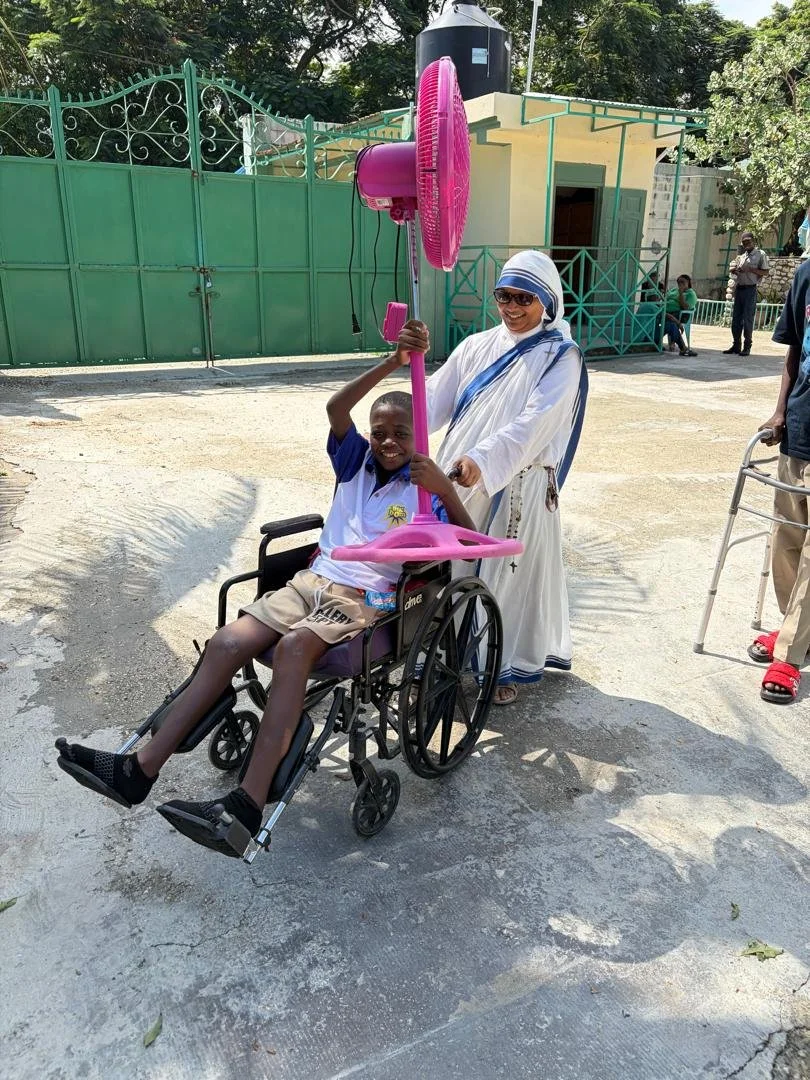
Lionel is in physical therapy, occupational therapy, and just starting school (he is a promising student). This is a picture of him leaving our morning mass just now, getting his fan back to his dormitory!
Thank you for your friendship, and for the sacrifices you make continually, to enable us to still be here in Haiti, with and for the poor.
Fr Richard Frechette CP DO
Port-au- Prince
October 4, 2026